

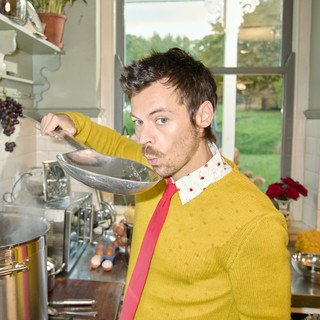
Harry Styles shrinks the room at his own Meltdown
At the Royal Festival Hall on June 16, Harry Styles — curator of 2026's Meltdown — handed his catalog to Jules Buckley's 50-piece orchestra and a gospel choir, dug out 'Two Ghosts' and 'Boyfriends,' and called a 2,000-seat covers set his career highlight.
Photo via Spotify
The Royal Festival Hall holds about 2,000 people. On June 16, Harry Styles — a man who sold out two-night stands at 60,000-seat stadiums for the better part of three years — chose to play it, and then chose to hand every song he played to a 50-piece orchestra. That decision, more than any single performance in the set, is the story. An arena act voluntarily walking into a room a thirtieth of the size, with strings instead of pyro, is a harder and more interesting move than another victory lap.
The curator plays his own festival
The occasion was Meltdown, the Southbank Centre’s long-running festival that hands the keys to a different artist-curator each edition. The list of past curators is its own argument for taking the gig seriously: David Bowie, Nick Cave, Patti Smith, Grace Jones, Yoko Ono, Robert Smith have all programmed it. For 2026, the Southbank gave it to Styles, and his lineup says more about his ears than any interview could — James Murphy, Dev Hynes, Kamasi Washington, and the great Beverly Glenn-Copeland all booked across the run. That is not a pop-star’s idea of a fun week. That is a record collector’s wish list.
Curating is the tasteful, low-risk part. Playing your own festival is where you actually expose yourself. Styles took the headline slot with the Jules Buckley Orchestra and the House Gospel Choir behind him, in a hall built for symphonies, in front of roughly 2,000 people who could see his face without a screen. There was nowhere to hide a weak song, and he seemed to know it. “It feels both present and incredibly not present to be so aware that you’re in the middle of your career highlight,” he told the room — the kind of line you only say out loud when you mean it.
The orchestra isn’t a backdrop
It helps that the strings were not a rented backdrop. Jules Buckley is one of the most accomplished arrangers working in this lane: the English conductor co-founded the genre-crossing Heritage Orchestra in 2004, has served as chief conductor of the Netherlands’ Metropole Orkest, and has won Grammys for his orchestral work with Snarky Puppy and Jacob Collier. Pairing with him is a signal all by itself. Styles didn’t hire a string section to sweeten the choruses; he hired one of the people who has spent two decades figuring out how to make an orchestra sound like a band instead of a film score. The 50 players and the House Gospel Choir were written into the songs, not draped over them, which is the difference between an orchestral show that means something and the kind of pops-night gimmick where the strings just double the vocal melody and wait for the key change.
The setlist as a thesis statement
Here is where the night declared itself. A pop star with this catalog walks into a one-off like this and plays the hits an orchestra can swell up nicely — “Sign of the Times,” “Falling,” the obvious ballads. Styles did almost the opposite. The thirteen-song set leaned on rarities and reworkings, and he pulled “Two Ghosts,” the aching cut from his 2017 debut, out of a drawer it hadn’t been opened from in roughly six years. He played “Boyfriends” and “Matilda,” the two quietest, most-exposed songs on Harry’s House and Fine Line. He played “Paint By Numbers,” “The Waiting Game,” “Coming Up Roses,” and a reading of “Carla’s Song,” threading orchestral interludes (“Matter Red,” “Hummingbird”) between them like movements.
What he conspicuously did not do was reach for “Watermelon Sugar” or “As It Was” — the streaming monsters, the songs that bought the house. Building a once-in-a-career orchestral night around your deep cuts instead of your biggest singles is a statement of intent. It says: I trust these songs to hold up without the production around them, and I’d rather show you the writing than the hits. For a performer whose public image has always run slightly ahead of his reputation as a craftsman, that is the more vulnerable choice, and the more convincing one.
The covers tell you where his ears point
The covers were the tell. Styles did two Patrick Watson songs — “Here Comes the River” and “Hommage” — and if you don’t know Watson, that’s the point. He’s a Montreal art-pop composer who writes the kind of cinematic, fragile chamber-pop that does not trouble the charts. Reaching for him in front of this audience is Styles pointing at his own influences rather than his own catalog. Then he closed the loop with Simon & Garfunkel’s “Bridge Over Troubled Water,” his first-ever live performance of it, and not a random pull: it’s the entrance music on his current Together, Together run, so the song he walks out to every night finally got sung. An orchestra and a gospel choir are exactly what that song was built for, and the room knew it.
Scaling down is the hard trick
Here’s why this matters beyond one good night. Most arena-scale pop acts genuinely cannot scale back. The thing that fills the stadium — the spectacle, the lights, the singalong machine — is load-bearing, and when you strip it away you often find the songs can’t carry the weight alone. The Love On Tour, which grossed north of $600 million, was one of the most charming arena shows of its decade precisely because it understood spectacle. Meltdown was Styles betting that the songs underneath the spectacle are good enough to stand in a concert hall with the lights up. On the evidence of the reviews, the bet paid: Variety called it a stunner, NME a masterclass, and the consensus landed on the same idea — this was a performer arguing, convincingly, for legacy-minded musicianship over pop maximalism. It also costs something to do. A 2,000-seat one-off for an act that moves arena tonnage means almost nobody who wanted in actually got in, which turns the rarities into a private reward for the few hundred people who did. Playing “Two Ghosts” for the first time in six years in that room, rather than to 60,000 phones, is the kind of choice that only reads as generous if you mean it.
You can hear the raw material that made the bet safe on the site already. Styles runs through the Your Top Songs 2021 and Your Top Songs 2020 rotations in his “Watermelon Sugar” and “Adore You” guise — peak-era, sunlit, radio-perfect pop. The Meltdown set is the same writer making the case that there was always more under the hood, and his full artist page is here if you want the catalog. If you want the companion argument from the other end of the rock spectrum, the Foo Fighters’ Tiny Desk note makes the identical point: take the production away, and you find out what’s actually in the song.
Whether this is a genuine pivot or a one-week detour, only Styles knows. But curating a festival of art-pop heads and jazz composers, then handing your own pop catalog to a 50-piece orchestra and choosing the deep cuts, is not the move of someone content to be the biggest pop star in the room. It’s the move of someone who wants to be the most serious musician in it. On June 16, in a 2,000-seat hall, he made the case.