

The Tiny Desk feature: eight performances we keep coming back to
A running feature on our favorite NPR Tiny Desk concerts — Foo Fighters, Bad Bunny, Sting & Shaggy, Anderson .Paak, Mac Miller, T-Pain, Usher, Coldplay — and how they line up with the artists already in heaviest rotation across this site. The format is the point: real bands in a real room, no production tricks, the song doing the work.
Cover via YouTube
We’ve started keeping a running feature on the NPR Tiny Desk concerts we love most, the ones that show up by name when we’re cataloging artists for this site. The Tiny Desk format — a small wedge of office space behind a literal desk that used to belong to Bob Boilen, four feet from a single camera, no monitors, no in-ears, no chance to hide behind production — has, over the better part of two decades, produced more honest performances by big artists than any other live format on the internet. It does this for the same reason a great DJ set does it: it strips out the tricks and leaves the song.
Below is the running list. Each entry pairs the Tiny Desk to what we already keep in heavy rotation across snoopspecial — playlists they show up on, artist pages with the long-form bio, the songs that earned their slot. We’ll add to this over time. If you have a Tiny Desk you think we missed, the contact form is the right place for it.
Foo Fighters (2026)
The most recent one, and the one that prompted this whole feature. The Foo Fighters did their first Tiny Desk this week — six members behind the desk, the new single “Spit Shine” first, “Everlong” last, and the rest of the catalog (Learn to Fly, My Hero, Child Actor) in between. Dave Grohl and Pat Smear both visibly enjoying themselves. We wrote it up in full here.
Why it lands: a stadium rock band shrinking down to office volume without losing the song. The arrangement of “My Hero” with Rami Jaffee’s organ holding the air where the wall of guitars usually lives is, on its own, worth the thirty minutes.
On this site: Foo Fighters — 62 tracks across 19 playlists. The dedicated 2011 set list is the one to start with; the catalog hits also live across Top Songs of 2019, Your Top Songs 2021, 90s Rock Hits #416, and the big party mix.
Bad Bunny (2023)
The cultural-event Tiny Desk. Bad Bunny showed up with a full band — drummers, percussionists, horns, a string section — to do an all-acoustic, all-Spanish set rooted in salsa, bolero, plena, and bachata traditions. The whole performance was conducted without the synth-and-trap signature of the rest of his catalog, and it was the version of him that the bigger pop audience didn’t yet know was in there. The end of the set, where he chokes up talking about his abuela, is the moment everyone forwards to.
Why it lands: an artist who had already won the streaming era using the Tiny Desk to remind everyone he could win the room without any of the tools that built the streaming numbers. The musical IQ on display is the whole argument for the format.
On this site: Bad Bunny — 12 tracks across 6 playlists, mostly on the Latin and weekend-kickoff mixes. He’s the artist where every additional Tiny Desk view feels like one more person finally hearing the band he’s always had with him.
Sting & Shaggy (2018)
The unlikely pairing that turned out to make total musical sense — Sting’s pop-craft and Shaggy’s Caribbean phrasing meeting on the dancehall-pop common ground they recorded their joint album on. The Tiny Desk did three songs from the 44/876 record plus, of course, a stripped-down “Englishman in New York” and “Boombastic.” It’s one of the most-watched Tiny Desks in the series’ history — last we checked, north of 75 million views — and it deserves every one of them. The two of them lean into each other on the harmonies in a way that, six years after the album, still feels surprising.
Why it lands: two of the most recognizable voices of the last forty years agreeing to share a room and a microphone, and figuring out a way to do it without either of them losing their signature.
On this site: Shaggy — 12 tracks across 8 playlists. His Sean Paul-adjacent dancehall canon shows up on the house party 2011 mix, party hits, and the old-school party. Sting we haven’t built into the rotation yet, but if you’ve been waiting for a reason to add a Police record to your party playlist, the Tiny Desk is it.
Anderson .Paak & The Free Nationals (2016)
The most-watched Tiny Desk of all time, per NPR’s own count — somewhere north of 110 million views and still climbing. The performance is the case-closed example of what the format does best: a real band, in real time, with a frontman whose drumming-while-singing trick still hasn’t been adequately copied in the decade since this set was filmed. The version of “Come Down” here is the one that made the song; the version of “Suede” with Knxwledge’s beat slowed for the room is the one that made the band.
Why it lands: in a series whose currency is intimacy, this is the Tiny Desk that most cleanly proved a band can move you in a small space the way they move you in a club. Anderson .Paak’s smile through the kit is the smile every musician should have at work.
On this site: Anderson .Paak — 18 tracks across 13 playlists. He shows up in the funk-and-soul-leaning weekend mixes and across the year-in-review lists; if you’ve been on this site for any stretch you’ve been listening to him for a while without necessarily knowing it.
Mac Miller (2018)
The Tiny Desk that became, after the fact, his last full live performance. Two months after the Swimming taping, Mac Miller was gone, and the set — five songs in his then-new jazz-leaning register, with a six-piece band led by Jon Batiste’s musical-director instincts and pianist Carter Lang — became the definitive document of where his music was going. Over 105 million views, an audience that grew steadily after he died, and a piece of footage that has aged into something close to sacred.
Why it lands: the performance is unforced. It’s a guy who clearly liked making music, in a room of people who clearly liked playing it with him, doing songs he’d worked out for months. The fact that it became an epitaph is incidental to how good it is on its own terms.
On this site: Mac Miller — 16 tracks across 7 playlists. His catalog runs deep through the mid-2010s weekend kickoffs and the rap-leaning party mixes; the late-career Swimming and Circles material in particular keeps coming back into rotation.
T-Pain (2014)
The Tiny Desk that, by the numbers, broke the series open. T-Pain showed up, sang every song without auto-tune, and the resulting fifteen minutes of unaltered vocals retroactively rewrote the public conversation about what kind of singer he is. The version of “Buy U a Drank” he does here is the version you should know — slower, looser, the melody clarified — and “Drankin’ Patna” gets a vocal performance that ends most arguments about the auto-tune-as-instrument debate.
Why it lands: a song catalog the world had decided was about studio trickery getting played by a singer with a real voice. The post-show internet response — equal parts surprise and apology — is its own piece of internet history.
On this site: T-Pain — 20 tracks across 6 playlists. The hits (“I’m in Luv (Wit a Stripper)”, “Bartender”, his Lonely Island feature) run through the strip club mix and the older party-rotation playlists; the Tiny Desk is the right introduction to T-Pain the singer if all you know is T-Pain the producer.
Usher (2020)
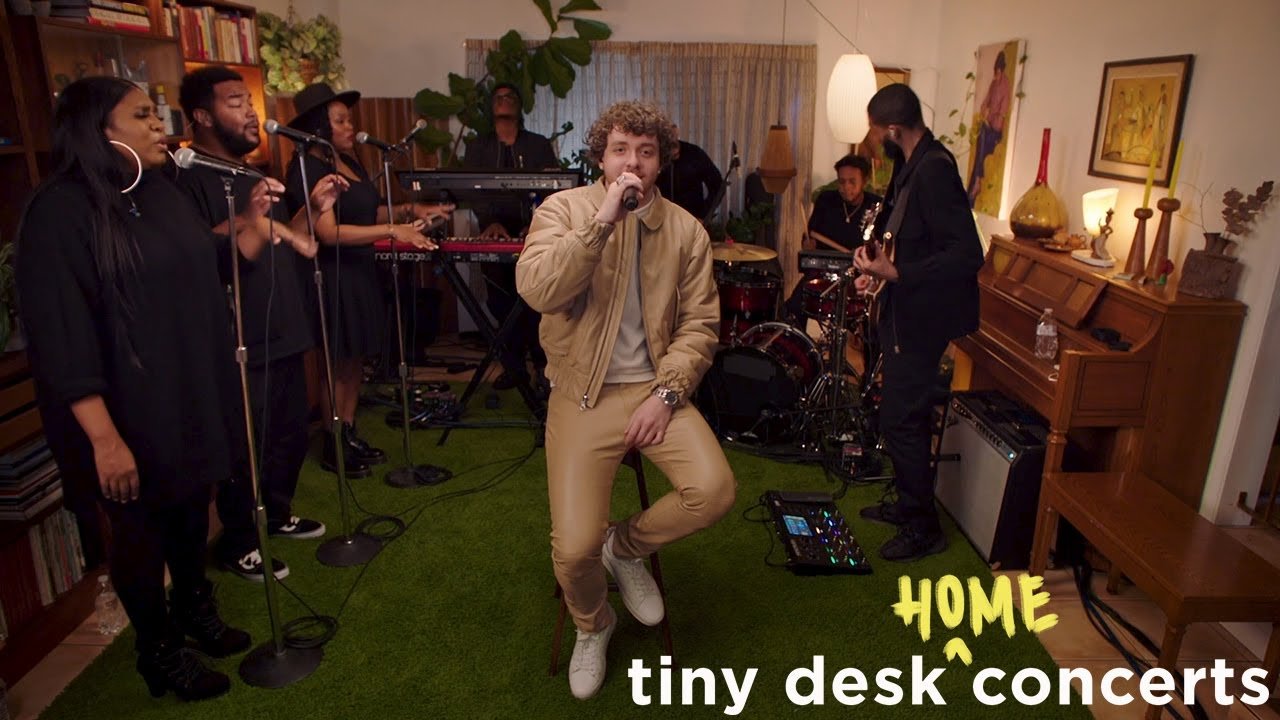
The Tiny Desk At Home — recorded in lockdown, from his own living room, with a tight three-piece backing band — is the version of Usher you didn’t realize you wanted. He opens with “Superstar” played mostly straight, runs through “U Got It Bad” and “Bad Girl,” and pulls a “There Goes My Baby” out of the bag that holds its own against any of his big-stage versions of the song. The whole set is fifteen minutes and you can do worse with your Tuesday afternoon than to put it on twice in a row.
Why it lands: an artist whose stage productions have always been productions showing that the songs themselves were the load-bearing beams all along.
On this site: Usher — 60 tracks across 23 playlists, which makes him one of the deepest catalog presences on the site. He’s everywhere: the house party mixes, the early-2000s R&B rotations, the weekend kickoffs. The Tiny Desk is the case for why.
Coldplay (2020)
The Tiny Desk Home Concert — Chris Martin alone at a piano, two acoustic guitars, no band, no crowd — recorded in a marble-floor room that gave the vocals a natural reverb the studio versions don’t have. He did “Trouble,” “Yellow,” “Cry Cry Cry,” “Champion of the World,” “Viva la Vida,” and the whole performance ran on the strength of the songs as piano-and-voice pieces. It’s the Coldplay set we put on when we want to remember why we ever cared in the first place.
Why it lands: a stadium band proving the songs work at the kitchen table. The version of “Yellow” he does here is the version you should send to someone who thinks the band peaked in 2002 — it’s the same song they think they remember, with twenty years of better singing on top of it.
On this site: Coldplay — 63 tracks across 28 playlists, which puts them in the top tier of our catalog. They show up everywhere from the wedding-band rehearsal mix to the long-drive playlists to the year-end best-ofs. The Tiny Desk Home Concert is the pairing we recommend with any of them.
The format itself
The thing we keep noticing across all eight of these is that the Tiny Desk’s structural constraint — small room, no production, four-foot distance to the camera — is doing the same thing a great mix does. It strips out everything except the song and the people playing it, and it forces the artist to make choices they wouldn’t otherwise make. The arrangement is the arrangement. The vocals are the vocals. There is nowhere to hide.
That’s also, not incidentally, what we try to do on this site. The playlists are sequenced. The notes are written by hand. The artist pages aren’t auto-generated bio scraping. The format is part of the curation. The Tiny Desks above are the ones we keep coming back to because they share the assumption: the audience can hear when you’re trying. Just play the song.
More entries to come as we work through the catalog. We’ll keep this page updated.